
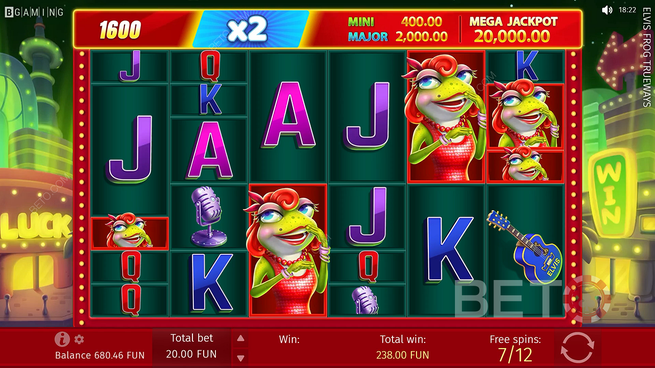





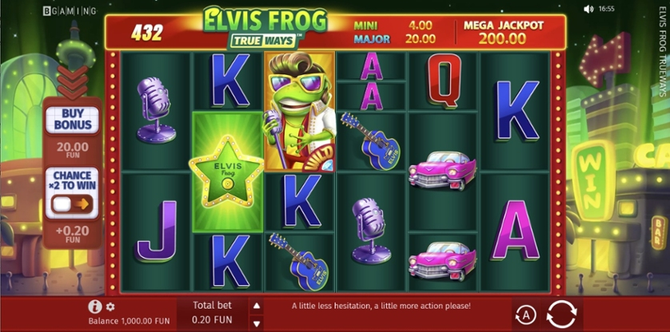
Play Elvis Frog TRUEWAYS in Denmark 18+
Try the game in test mode, learn the buttons, set time and budget limits, and play calmly in Denmark — 18+ only, without pressure.
How to Use the Elvis Frog TRUEWAYS Demo in Denmark
The smart thing about starting in test mode is that you can learn the rhythm without chasing anything. Imagine you only have 20 minutes after dinner, yet you end up spending half of it searching for settings and history. When you practice in a free trial, you learn where things are, so you can play briefly and stop precisely, instead of 'getting stuck' because you got irritated.
Begin by making your session boring—in a good way: set a timer on your phone, choose a low default stake, and decide on a fixed stop time before you even press spin. Use the first rounds to check three things: how clearly the game displays the current stake, how easy it is to change it without accidental clicks, and whether you can find pause and history in one second. It sounds small, but these small decisions determine whether a session stays controlled or runs away.
If you’re playing on mobile, think practically: stable internet, sufficient battery, and fewer distractions. Consider enabling 'Do Not Disturb' if notifications cause you to lose focus. In 2026, the mobile device is the primary place for gaming, meaning comfort and control must reside in the same hand. Once you’ve mastered the flow, you can assess whether the game fits your habits—not the other way around.
Elvis Frog TRUEWAYS Demo: What You Need to Learn Before Betting
The demo is best used as an exercise in understanding, not as a prediction. Imagine getting a small win early on and thinking, “this is how it’ll probably go.” That’s exactly where the test helps: you can observe how you react to variance, without your next choices being driven by chase or irritation.
Use the demo mode to get a feel for tempo and signals. Pay attention to how often “something” happens on screen, how long a round feels, and how easy it is to stop mid-rhythm. Also notice what makes you more impulsive: fast sounds, large animations, or simply the fact that you haven’t set a timer. The more aware you are of your triggers, the easier it becomes to manage a real session later.
Pay special attention to decision points: do you change stakes when you get bored? Do you keep playing when you’re tired? Do you linger, expecting a certain feature “just around the corner”? If the answer is yes, the solution is not to “pull yourself together”, but to tighten the framework: shorter sessions, clearer stop cues, and pauses that truly break the rhythm. And remember: gambling in Denmark must be for adults only (18+), so a mature mindset also means stopping when the plan says stop.
Getting Started With Account and Mobile Security
It’s tempting to jump straight into the game, but setting up your account calmly pays off later. Imagine you plan to play for five minutes, only to discover you can’t log in because you used an old email address or phone number you no longer have access to. Such small mistakes turn a short session into a lengthy ordeal—and that’s precisely where many end up playing longer than intended, simply because they’re already “in motion”.
Therefore, do the boring stuff first: use contact details you actually check, choose a strong password, and secure your phone with a PIN or biometrics. When playing—especially on mobile—it’s also worth considering privacy: not everyone needs to see your screen on the bus. Disable notification previews on the lock screen if you want to avoid accidental glances.
The most important thing in 2026 is order and repeatable habits: one account, one device at a time, and one change at a time, if any corrections are needed. This makes troubleshooting easier and reduces stress when handling deposits, withdrawals, or support.
Registration and Age Verification Without Stress
Registration should feel like filling out a simple form—not like a battle. Imagine registering late at night, when you're tired, and autocorrect changes your name by one letter. It seems inconsequential at the moment, but could cause issues later when your data needs to match up. The solution is simple: fill it out calmly, double-check once more, and don’t delay the process until you’re already distracted.
Keep the 18+ requirement in mind from the start. If steps require confirmation, follow the screen order rather than skipping around. Avoid making multiple changes at once—if you change both your email and profile info simultaneously, it becomes harder to understand what triggered a potential verification check. A stable approach is: change one thing, confirm it, then proceed.
Time and Budget Limits Settings Before First Spin
Limits only work if they’re realistic and easy to stick to. Imagine setting a limit so high that you never reach it—it then becomes just a nice idea that doesn’t actually stop you. Be concrete: choose a time limit per session, select a weekly amount you can comfortably spare for entertainment, and commit to not topping up multiple times within the same session.
A practical method is using “blocks”: 10–15 minutes of play, 2-minute break, then either stop or start a new block. The break must be physical—stand up, drink water, look away from the screen. This breaks autopilot mode. If you notice you often negotiate with yourself (“just five more minutes”), set your stop point earlier and shorten your blocks.
Privacy on Mobile and in Public
Your screen is more public than you think. Imagine sitting on a train, about to check your history, when someone suddenly stands close behind you. You lose focus, press the wrong button, and suddenly everything feels messy. A few simple habits help: lower the brightness, use “do not disturb”, and avoid saving sensitive screenshots longer than necessary.
If you share your phone with others at home, fully log out after each session. This isn’t about distrust—it’s about avoiding misunderstandings and accidents. When you play, you want every choice to come from you—not from a phone left unlocked for two minutes.
If Login Fails: Quick Troubleshooting Calmly
When something goes wrong, speed is your enemy. Imagine the app won’t open, and you keep tapping repeatedly until you trigger a temporary lockout. Instead, stop. Close the app, check your network, restart your phone, and try once. If issues persist, note what happened: when, after which step, and what message you saw.
Avoid changing your password, email, and profile all at once while already frustrated. This causes confusion and makes it harder to get help. A calm routine: regain access first, fix one thing at a time afterwards, and only return to playing once you’ve fully regained control.
Deposits and Withdrawals with Clarity in Denmark
The money aspect should be the most mundane part of the experience. Imagine depositing several small amounts because you get carried away, only to later not recall exactly how much you spent. Clarity starts with one rule: you deposit only when you have a plan, and you stop when that plan is fulfilled. This is especially important in 2026, since mobile devices make it easy to “just do it again” without thinking.
Stick to methods that feel transparent to you: where you can see amounts clearly, where you can track history, and where you’re not tempted to break expenses into many small deposits. Before requesting a withdrawal, verify your profile details are correct and up to date. Many issues arise when people update information after submitting a request because they “suddenly remembered something”—this can unnecessarily complicate the process.
Here’s a practical table to help you track your steps without promising specific times or outcomes:
Step in the Process | What You Do | What You Check Before Confirming | Common Pitfall |
Before Deposit | Set a budget and time limit | Ensure the amount fits your plan | “Just a little more” multiple times |
During Deposit | Confirm the amount once | That you don’t switch methods mid-process | Repeated attempts due to poor connection |
Before Payout | Review profile and history | That contact details are active | To correct profile upon request |
When Status Is Pending | Wait and check history | Whether there’s a message in the account | That sending a new request too early |
When You Need Help | Write down what happened | Time, last step, message | To explain without details |
Choose a Payment Method That Supports Your Budget
The “best” method is the one that helps you stick to your limit. Imagine choosing a method where small amounts feel invisible, and you end up depositing in small increments all evening. It doesn’t feel significant until you see the total. Instead, choose an approach that makes the amount clear and makes it easy to say stop.
If you want to make it even easier, introduce a personal rule: one deposit per session. When you feel the urge to deposit again, it’s a signal to take a break—not a signal to continue. In practice, this rule often offers the strongest protection against impulsive behavior.
Payout Without Creating Extra Checks
The most stable payout routine is: clean up first, submit afterward. Imagine submitting a request and then discovering an error in your profile. You may be tempted to change it right away, but this can make the process more cumbersome. The calmer solution is to pause, correct profile details first (if needed), confirm they’re saved, and then submit the request.
Avoid submitting multiple payouts “just in case.” This creates unnecessary work and can make it hard to see what’s active. Check your history and account messages, and contact support with specific information if unsure. A precise explanation yields faster help than an emotional one.
When Something Is Pending: What to Do—and Not Do
Pending status can trigger impatience. Imagine seeing “pending” and immediately pressing again because you want control. Suddenly, you have two processes running, and you’re unsure which one is active. The best practice is to keep your hands off: check history, wait a reasonable time, and see whether an in-app message requires your action.
If nothing happens, switch strategies: document the situation (time, last step, screen message) and contact support calmly. Avoid switching payment methods or altering your profile while waiting. Keep your process clean, so both you and support can see what’s truly happening.
Gambling Habits: Choose Games, Stake, and Stop Intentionally
It’s not the single round but your habits that shape your experience. Imagine entering to play a bit, only to end up switching games because you feel restless. This often drives stakes higher, as you chase the sensation of “feeling something.” A better habit is choosing one game, playing a short session, and stopping—regardless of whether you just won or lost.
Plan your session as a mini routine: check time limit, verify budget, choose stake level, and start. When the timer rings, you stop. If you wish to continue, take a break and make a new decision. This may sound strict, but it actually makes the experience more relaxed, because you no longer constantly negotiate with yourself.
In Denmark, it’s also good practice to keep the 18+ boundary clear for yourself. If you’re playing as an adult, play as an adult: protect your sleep, finances, and peace of mind. Gaming should be entertainment—not a test of your willpower.
How to Find a Game That Fits Your Evening
Games should match your energy. Imagine being tired and choosing something fast and intense—only to find yourself needing to pay closer attention, leading to longer and more impulsive play. Instead, choose based on tempo: if you want calm, pick calm; if you want short bursts of intensity, set a tighter timer and a lower budget.
Spend two minutes understanding the game’s basic rules, and start with a low stake. If you notice restlessness and constant urges to switch games, it’s a sign to shorten—not extend—the session. It’s completely normal to have days when gaming doesn’t fit; on such days, the best choice is to close the app.
Stake Management That Prevents Escalation
Escalation often begins with a “small adjustment.” Imagine losing a few rounds and thinking, “I just need to raise stakes a bit to get back on track.” Suddenly, the stake is no longer part of your plan but a reaction. The safest method is to define two numbers before you begin: a standard stake and a maximum limit. Once you hit the limit, stop or take a longer break.
If you want to make it even more robust, adopt a rule: change your stake only once per session. This forces you to pause and think before acting. And when you feel the urge to chase, take the break first. In practice, the break is often the action that restores the most control.
Autospin and Quick Spin: Use With Boundaries
Automated features can be convenient but may remove your natural stopping point. Imagine setting autospin and stepping away for a second—only to find yourself deep into a session you no longer actively control. If you use this feature, set a low round count and a clear stop. Use it as a tool, not as an engine running on its own.
A good technique is combining autospin with a timer: short autospin blocks, followed by a break and a conscious choice to continue or quit. This introduces friction at the right moments. If you notice autospin makes stopping harder, disable it. Control matters more than comfort.
Timeout and Self-Exclusion When Patterns Repeat
Timeout is for days when you sense you have no reserves left. Imagine playing to suppress stress, only to feel more pressure. At that point, timeout is a mature decision—not a punishment. It gives you space to regain calm and return later—or choose not to return at all that day.
Self-exclusion is a stronger tool when patterns recur. If you frequently break your own limits, exceed stakes without planning, or regret actions afterward, it’s a clear signal. Use strong tools for strong patterns. The goal isn’t to “prove” anything but to protect your daily life.
Support and Closure: Keep the Process Clean
When something goes wrong, it’s easy to do everything at once. Imagine spotting an error and then changing your password, reinstalling, editing your profile, and trying again—all while still frustrated. Now you don’t know what worked—or caused the issue. A better approach is one change at a time: check your network, close the app, restart, and try once. If that fails, contact support with precise details.
Closing your session is just as important as starting it. Briefly check history, confirm no pending actions remain, and close. If playing on a mobile device in public, log out—especially if sharing the device. A clean closure makes your next session calmer, because you don’t carry doubt forward.
60-Second Checklist Before and After Playing
The Check-In is your shortcut to calm. Imagine opening the game with no plan, and after 10 minutes, you can’t remember what you decided. Instead, use 60 seconds: set a time limit, confirm your budget, and check your mood. If you’re not calm, delay. It’s an adult choice.
After the session, do the same in reverse order: check history, check for any pending items, and close. If something is unclear, do NOT “fix it with more clicks.” Wait, document, and contact support with facts. This habit saves time and keeps you out of stress-driven sessions, which often lead to longer play sessions.
FAQ
How do I test the game without losing control?
Start with a short session and clarify the boundaries before hitting spin: set a timer, choose a low stake, and decide on a stop point. Imagine you win a small amount and feel inclined to continue “just a little.” Here, the timer is your best friend, as it forces a new decision. Take a physical break when it rings, and only continue if you still stay within your plan. If you cannot explain why you continue, it’s often a sign of autopilot. Close and come back another day when you’re calm.
Which limits make the most sense for a short evening?
A time limit and a budget limit that are realistic enough to actually be triggered. Imagine setting the limit so high it never activates—it won’t stop you when you’re swept up. Instead, choose a time limit at a level you can realistically maintain, and an amount appropriate for entertainment—not a pursuit. Use blocks: 10–15 minutes, break, and stop after one or two blocks. If you frequently break the rules, make them easier to follow: shorter time, fewer blocks, and a rule of one deposit per session. It may sound strict, but it brings calm because you don’t have to negotiate with yourself constantly.
What should I do if I feel the urge to increase my stake?
Stop and treat the urge as a signal—not an order. Imagine you lose a couple of rounds and think a higher stake will “fix” it—that’s typically an emotional reaction. Use a simple framework: standard stake and a maximum limit, set before you start. When you feel like ramping up, take a two-minute break and check whether you’re still within your plan. If you’re already over budget, close the session. If you continue, stick with the standard stake—not the urge. Over time, this habit turns gaming into entertainment, not a chase.
How do I avoid confusion around deposits and withdrawals?
Make the money part as simple as possible and keep the process clean. Imagine you submit a withdrawal request and then change your profile information because you “just remembered something.” This can create extra checks and confusion. The better routine is: update your information first, confirm it’s saved, then submit one request only. Avoid sending multiple requests “just to be safe,” and check your history before clicking again. If the status shows “pending,” wait a reasonable amount of time and check your account for a message. Contact support with the timing, last step, and message if nothing happens. This leads to faster help than repeated clicking.
What signs show I should take a timeout?
The signs are concrete—not mystical. Imagine “I’ll stop in five minutes” keeps shifting, or you deposit again without a plan, just to keep going. If you become irritable, restless, or start chasing losses, it’s often the right time to stop. A timeout gives you distance so you can make decisions free of heightened emotions. If this pattern repeats across sessions, a longer break or self-exclusion might be more effective than willpower alone. The goal isn’t to beat yourself—it’s to protect your finances, your sleep, and your calm.
How do I play more safely on mobile in daily life?
Make mobile a place with fewer temptations and more control. Imagine playing in public, being interrupted by notifications, and losing focus—that increases the risk of misclicks and longer sessions. Disable notification previews, use lock screen with PIN or biometrics, and play only when you have stable connectivity. Plan short sessions with timers, and fully close when time’s up. Check history shortly after the session so you don’t carry doubt with you. If something is unclear, document it and seek help with facts—not by clicking onward in frustration. This is the most stable way to keep gaming as entertainment within 18+ boundaries.